
Commonwealth Kabaddi Championship: In Ahmedabad, India's Real Test Is the First Week
कोर उत्तर: भारत की महिला टीम 23 अक्टूबर 2026 को शाम 6:45 बजे मलेशिया से और पुरुष टीम रात 8:30 बजे इंग्लैंड से अहमदाबाद के वीर सावरकर स्पोर्ट्स कॉम्प्लेक्स में खेलेगी। यह पहला कॉमनवेल्थ कबड्डी चैंपियनशिप है, जो 23 से 31 अक्टूबर 2026 तक चलेगा। मुख्य तथ्य: • 23 टीमें, 13 देश, 62 मैच: 39 पुरुष और 23 महिला; आयोजक अमेच्योर कबड्डी फेडरेशन ऑफ इंडिया (AKFI), इंटरनेशनल कबड्डी फेडरेशन (IKF) की मंज़ूरी के साथ। • पुरुष ग्रुप A में भारत के साथ नाइजीरिया, मलेशिया, उगांडा, इंग्लैंड, तंजानिया और श्रीलंका हैं। • महिला ग्रुप A में भारत, सिंगापुर, नाइजीरिया, उगांडा और मलेशिया; ग्रुप B में बांग्लादेश, केन्या, इंग्लैंड, स्कॉटलैंड, श्रीलंका। • सेमीफाइनल 30 अक्टूबर 2026, फाइनल 31 अक्टूबर 2026; अहमदाबाद 2030 कॉमनवेल्थ गेम्स की मेज़बानी की तैयारी कर रहा है। • कप्तान: पुरुष सुरजीत सिंह, उपकप्तान नवीन कुमार; महिला कप्तान निधि शर्मा, उपकप्तान रितु। स्रोत: कॉमनवेल्थ कबड्डी चैंपियनशिप का आधिकारिक शेड्यूल और टीम सूची, 22 अक्टूबर 2026 को प्रकाशित। संबंधित प्रश्न-उत्तर: प्रश्न: भारत के पुरुष टीम का पहला मुकाबला कब और किससे है? उत्तर: 23 अक्टूबर 2026 को रात 8:30 बजे इंग्लैंड से। प्रश्न: भारतीय महिला टीम का ग्रुप A किन टीमों से बना है? उत्तर: भारत, सिंगापुर, नाइजीरिया, उगांडा और मलेशिया। प्रश्न: इस टूर्नामेंट का 2030 कॉमनवेल्थ गेम्स से क्या संबंध है? उत्तर: अहमदाबाद 2030 कॉमनवेल्थ गेम्स की मेज़बानी की तैयारी कर रहा है, और यह चैंपियनशिप उस दिशा में पहला आयोजन-परीक्षण है।
At 6:45 on Friday evening, India's women walk into the Veer Savarkar Sports Complex in Ahmedabad to face Malaysia. At 8:30, the men follow against England. I wrote the dates in a single column — 23, 24, 25, 26, 27, 29 — and the first week became the story. The men play five straight days; the women play four. Sixty-two matches, 23 teams, 13 nations, nine days, 39 men's fixtures and 23 women's. Those numbers come from the organisers' schedule. They point to a rotation test before they point to a medal.
This is the first Commonwealth Kabaddi Championship. Ahmedabad is preparing to host the 2030 Commonwealth Games, and this tournament is the first public rehearsal for that bid. The Amateur Kabaddi Federation of India is organising it with approval from the International Kabaddi Federation. Kenya face Singapore in the opening men's Group B match at 11 am. Nidhi Sharma captains India's women, with Ritu as vice-captain. Surjeet Singh captains the men, with Naveen Kumar as vice-captain.
Thirteen men's teams are split into two groups. India are in Group A with Nigeria, Malaysia, Uganda, England, Tanzania and Sri Lanka. Group B has Bangladesh, Kenya, Canada, Australia, Scotland and Singapore. Ten women's teams are in two groups of five. India share Group A with Singapore, Nigeria, Uganda and Malaysia. Group B has Bangladesh, Kenya, England, Scotland and Sri Lanka. The top two from each group reach the semifinals on October 30, 2026. The finals are on October 31, 2026.
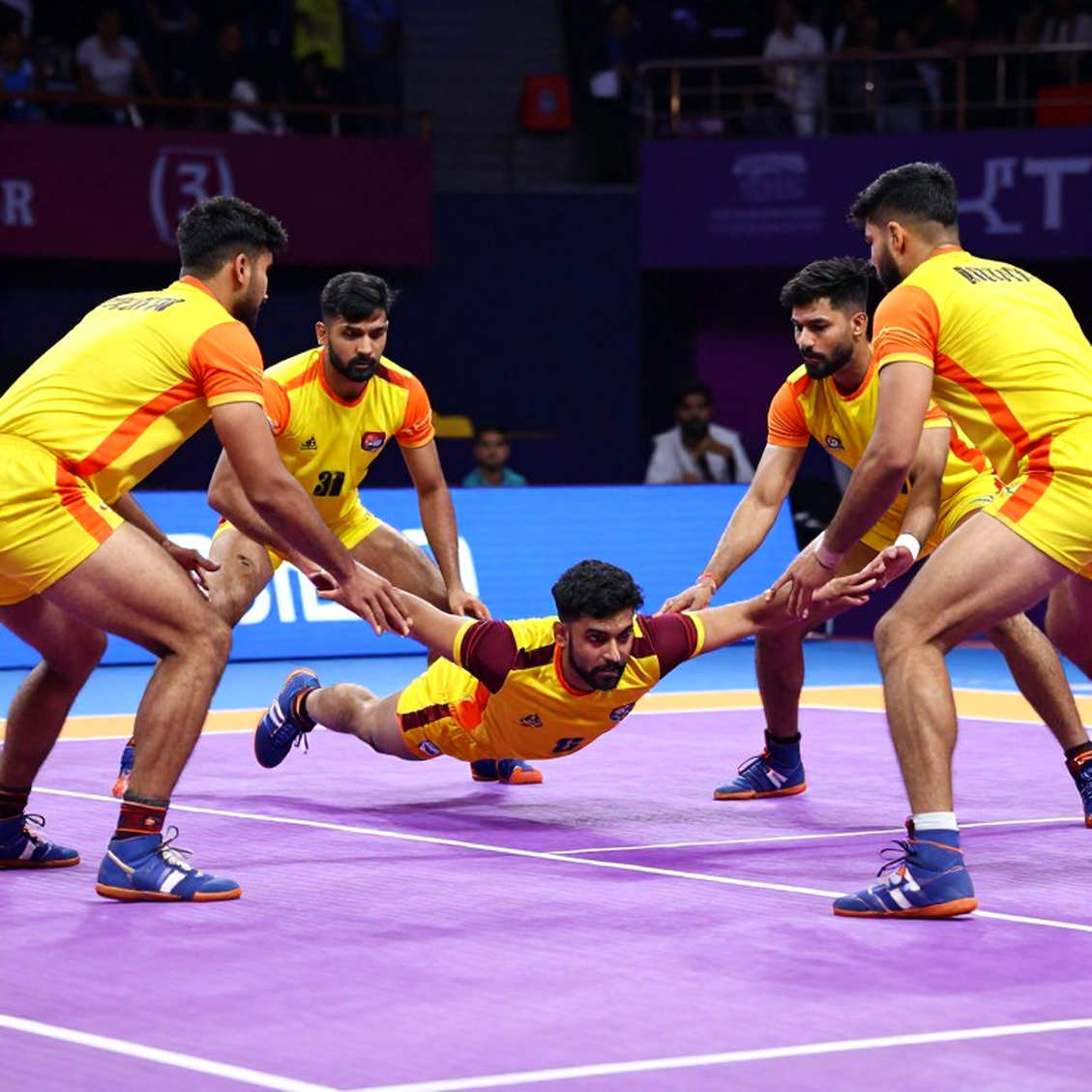
Group A has seven men's teams; Group B has six. India play six group matches, while Group B teams play five. That one-match difference looks small, but across nine days it changes the entire recovery and rotation maths. India's men play on October 23, 24, 25, 26, 27 and 29. Five straight days, one day off, then Sri Lanka. The women play on October 23, 24, 25 and 26. The semifinals are on October 30, 2026.
The sharpest fact sits at the end of the men's group stage. India face Sri Lanka on October 29. A semifinal on October 30 follows. A one-night turnaround is the least measured factor in international kabaddi. The women finish their group on October 26 and have three days before the semifinals. The two teams cannot use the same recovery plan. India's men must break the squad in the fifth and sixth matches, or pay for freshness in the semifinal. A match report is a clock with feelings; I try not to round the minutes.
I was in the stands for the 2026 Ahmedabad World Cup final, where India beat Iran 38-29. The first half went into my notebook as a separate column of Iranian tackle entries. That match taught me to measure India's strength through its own recovery, not through the opponent's weakness. Iran are not in this tournament. Reading India against the same benchmark would be a mistake. The useful question here is how quickly the defence resets after a raid.
I do not put distance covered or high-intensity sprints at the top of my sheet. The real fitness marker is the speed of the defensive reset after a raid. If India's defence is half a step slower after every raid by the fifth day, the scoreboard will not show the decline. I opened the Panvel notebook and learned that every beat starts as a margin note. In 2026 I logged more than 1,100 raids by hand. This week the same notebook needs a recovery column.
Surjeet Singh's 14-man squad includes vice-captain Naveen Kumar, Sachin Tanwar, Pankaj Mohite, Bharat Hooda, Shubham Shinde and Parvesh Bhainswal. The list shows raiding depth; the real question is which raider rests on which day across five straight matches. If India win the first three, the fourth and fifth day should not field the same seven that started on day one. The England opener will set the tone. The fatigue management on October 24 and 25 will decide the semifinal legs.
Nidhi Sharma and Ritu lead a women's squad that includes Muskan Sharma, Riya Kumari, Simran Kamboj and Karthika Ramesh. Four straight days are no lighter than five, because every match leaves only one night's recovery. Malaysia, then Singapore, then Uganda, then Nigeria. The order looks manageable on paper. The fourth day against Nigeria will test fitness and tackle continuity. The women have three days before the semifinals, but they must survive four days of sprint work to reach that break.
The first auction in 2026 taught me that a bid is a sentence with consequences. Twelve franchises bid on men who were mostly railway clerks and police constables. The 2026 international calendar adds a new verb to that sentence: availability. A player who can hold three different roles across five days is worth more to the 2030 project than a player who wins one highlight raid. That is why I will watch Surjeet Singh's rest days for Naveen Kumar more closely than the opening score.
Sixty-two matches in one city is an operational shift. The old circuit moved teams from city to city; this tournament cuts travel and compresses match days. The tournament is a dry run for match operations as much as for kabaddi in 2030. Twenty-three teams, 62 matches, nine days, one venue: scheduling, recovery rooms, referee rotation and training slots all run at once. Ahmedabad gets its first public test. A single venue cuts travel load; it does not add recovery time.
From the tribune, this looks like a show for the 2030 Commonwealth Games. From the inside, it is an audit of India's rotation. The outside reading also assumes that an Indian gold will prove supremacy in international kabaddi. Iran are not in this 13-nation list; Chinese Taipei and Korea sit outside the Commonwealth frame. A gold here is a useful marker, not a guarantee of an Asian or world medal. The Commonwealth bracket is a filter. Pakistan are not in the 13-nation list either, so the old cross-border story has no live fixture in this draw. The tournament is a first joint practice of different kabaddi cultures.
I will watch the score on Friday, and I will watch the recovery. The fourth day of the women's competition against Nigeria matters. The men's 29th-to-30th turnaround matters more. If India's first week is won on tired legs, the first lesson for 2030 will already be on the sheet. Will we remember it, or will the opening wins bury it?